Exporting a book

Export turns the story into a file you can read, print, send or publish elsewhere. Unlike a backup it contains only the text, as a finished book.

Only the active branch is exported - the same parts the story editor shows. To export another version of the story, switch to that branch first.

Exporting

  1. Open the book and go to the Story tab.

  2. Open the settings menu (⚙) in the bottom bar and choose Export story.

  3. Fill in the dialog and choose Export.

  4. Marginalia collects the parts of the branch and writes the file, which takes a moment for a long book. A progress bar shows how far it is.

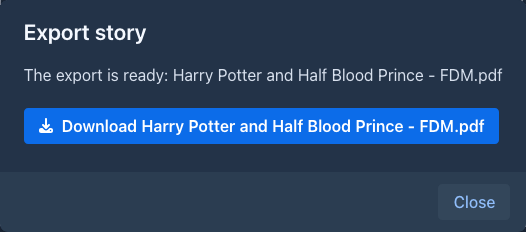
  5. When the file is ready, a dialog offers it for download. Choose the Download button to save it.
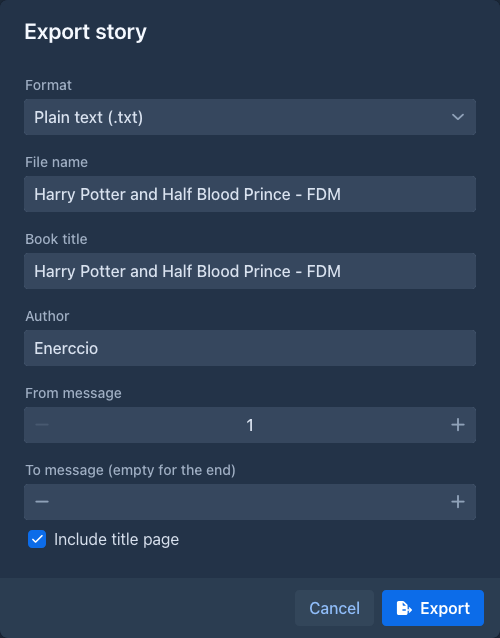
The Export story dialog
Field  
Format The file type, see below.
File name Name of the downloaded file without the extension, which Marginalia adds. Starts as the name of the book.
Book title The title in the file (title page and file properties). Starts as the name of the book; changing it doesn't rename the book.
Author Starts as your full name from your account. Empty means no author.
From message, To message Which parts to export. Parts are counted from 1 in the order of the story, parts without text are not counted. Leave To message empty to export to the end.
Include title page Starts the file with a first page holding the title and the author.
The finished export, ready to download

Formats

Format  
Plain text (.txt) Just the text in UTF-8. Formatting such as italics is dropped, paragraphs are separated by an empty line.
Markdown (.md) The text as it is written in the story, for editors such as Obsidian or Typora, a static site or a repository. Emphasis, headings, quotes, lists, code blocks and scene breaks stay Markdown. Raw HTML in the text is kept as typed, the Markdown reader decides whether to show it.
HTML (.html) One page with a book-like style included, so it looks the same in every browser. It can be printed and has no external files.
Word document (.docx) Opens in Word, LibreOffice and similar programs. Justified text, with the title and author set in the file properties.
PDF (.pdf) A5 pages with embedded fonts that cover Latin, Greek and Cyrillic text.
EPUB (.epub) An e-book for e-readers and reading apps. Long books are split into several files inside the EPUB so readers stay fast.

The text of the parts is Markdown. Emphasis, headings, quotes, lists, code blocks and scene breaks (---) are kept in every format that can show them. Raw HTML in the text is shown as text, never run.

Images of the parts are placed after the text of their part, with their captions:

Format  
HTML Embedded in the page, so it is still one file.
Markdown Embedded in the file as ![caption](data:...) images with the caption in italics under them, so it is still one file. Not every reader shows embedded images (GitHub does not), and a book with many images has very long lines, so attach images to the parts only when you want them in a Markdown export.
EPUB, Word document, PDF Embedded in the file and scaled to fit the page.
Plain text Marked with [Image] or [Image: caption].

Table of contents

When the text contains chapters, the file gets a table of contents after the title page. A chapter is a part of the story that contains a Markdown heading (a line starting with #, e.g. # Chapter 3: The Harbour) - the same rule the Chapter Marker plugin uses in the story sidebar. The first heading of a part is its title, parts without a heading belong to the chapter before them. A story without any heading has no table of contents.

In PDF, Word and EPUB every chapter starts on a new page. The title page and the table of contents are pages of their own as well.

The entries are links to the chapters:

Format  
HTML Links to the chapters of the page.
PDF Clickable entries with the page of the chapter, and the chapters are also in the outline (bookmarks) your PDF reader shows next to the pages.
EPUB The table of contents of the reader, which is also a page of the book after the title page.
Word document (.docx) Clickable entries with the page of the chapter. Word asks to update the fields when it opens the file, answer Yes to fill in the page numbers (LibreOffice fills them in on its own). It is a list of links and not a Word table of contents field.
Markdown No table of contents. The chapter headings stay in the text, and most Markdown editors build an outline from them.
Plain text No table of contents.

Page numbers

The PDF and Word files have the page number in the footer of every page except the title page. The number is the position of the page in the file, so the title page is page 1 and the first page after it is page 2. The other formats have no pages of their own.

The title page

With Include title page, the file starts with the book title and the author on a page of their own. The page is made from a built-in template (DEFAULT_EXPORT_HEADER_TEMPLATE), which isn't editable in the application yet.

Good to know

  • The export is a snapshot of the branch when you choose Export. Parts generated or edited afterwards are not in the file.

  • The exported file is kept only until you close the download dialog. Export again if you need it later.

  • Summaries, lorebooks, instructions and the model's reasoning are not exported, only the text and the images of the parts. To save all of it, make a backup.